
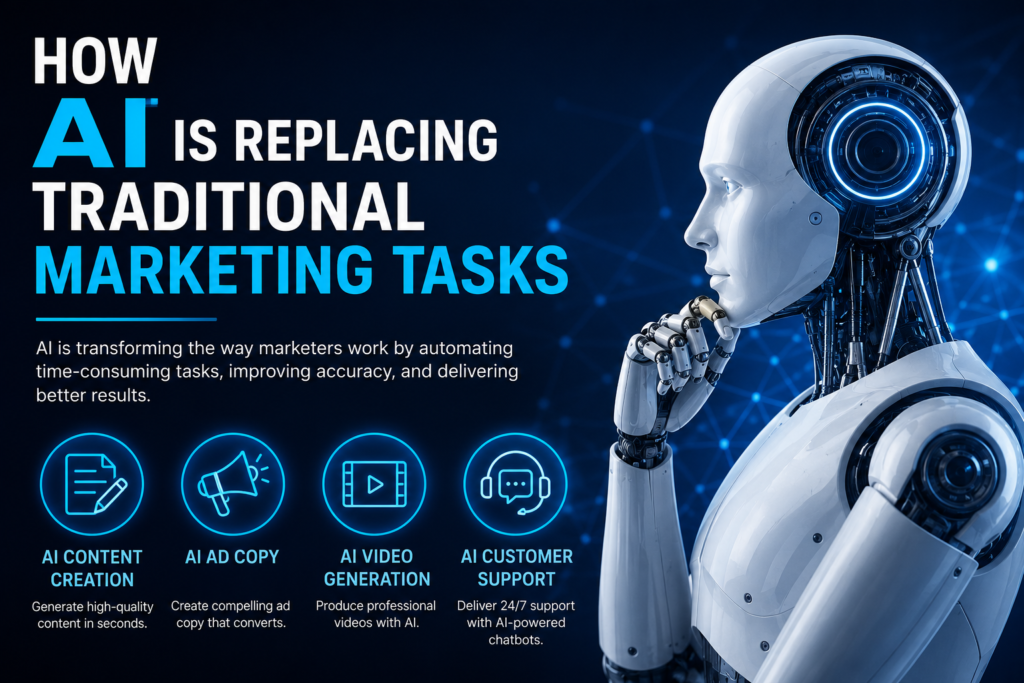
Artificial Intelligence (AI) is no longer a futuristic concept—it has become a core part of modern digital marketing. Businesses of all sizes are using AI to automate repetitive tasks, improve customer experiences, and make smarter marketing decisions. From creating engaging content to generating ad copy, producing videos, and handling customer support, AI is transforming the way marketers work.
Rather than replacing marketers completely, AI is changing their roles. It takes over time-consuming tasks, allowing marketing professionals to focus on creativity, strategy, and relationship building. Let’s explore how AI is replacing traditional marketing tasks and what this means for businesses in today’s digital landscape.
1. AI Content Creation: Faster, Smarter, and More Personalized
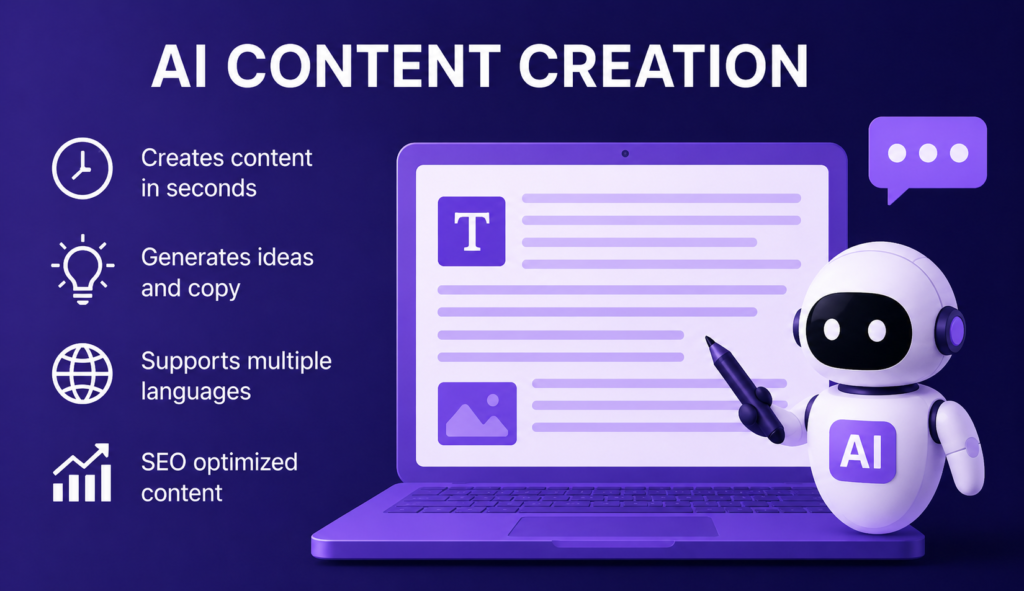
Creating high-quality content has always been one of the biggest challenges for marketers. Writing blog posts, social media captions, email newsletters, website copy, and product descriptions can take hours or even days.
AI-powered tools have dramatically changed this process. Platforms such as ChatGPT, Jasper, Copy.ai, and Gemini can generate well-structured content within minutes. Marketers simply provide a topic, keywords, or a brief prompt, and the AI creates a draft that can be refined and personalized.
Benefits of AI Content Creation
- Saves significant time on writing tasks.
- Generates ideas for blogs, videos, and social media posts.
- Creates multiple content variations for different audiences.
- Helps maintain a consistent publishing schedule.
- Supports multilingual content creation for global businesses.
For example, an e-commerce company launching a new product may need product descriptions, promotional emails, Instagram captions, and blog articles. Instead of assigning separate writers to each task, AI can generate first drafts quickly, allowing the marketing team to focus on editing and brand consistency.
However, human creativity remains essential. AI-generated content should always be reviewed to ensure it reflects the brand’s voice, provides accurate information, and delivers genuine value to readers.
2. AI Ad Copy: Smarter Advertising with Better Results
Writing persuasive advertisements requires creativity, audience understanding, and constant testing. Traditionally, marketing teams spent hours brainstorming headlines, descriptions, and calls to action before launching campaigns.
AI has made this process much more efficient.
Modern advertising platforms use AI to generate multiple ad variations based on campaign goals. AI can analyze customer behavior, previous campaign performance, demographics, and search intent to recommend ad copy that is more likely to convert.
Advantages of AI Ad Copy
- Generates multiple headline and description options instantly.
- Optimizes messaging for different customer segments.
- Improves click-through rates through continuous testing.
- Personalizes advertisements based on user interests.
- Reduces the time required to launch campaigns.
For example, a travel company promoting holiday packages can use AI to create different ads for families, couples, and solo travelers. Each audience receives personalized messaging, increasing the likelihood of engagement and bookings.
AI also supports A/B testing by automatically comparing different versions of an advertisement and identifying which performs best. This allows marketers to improve campaign performance with less manual effort.
3. AI Video Generation: Revolutionizing Visual Marketing
Video marketing has become one of the most effective ways to engage audiences. However, producing professional videos traditionally required scriptwriters, designers, editors, voice-over artists, and expensive equipment.
AI video generation tools are changing this landscape.
Today’s AI platforms can convert text into professional-looking videos complete with animations, voice narration, subtitles, transitions, and background music. Businesses can create marketing videos, product demonstrations, training materials, and social media content much faster than before.
Benefits of AI Video Creation
- Produces videos in minutes instead of days.
- Reduces production costs.
- Creates videos suitable for multiple platforms.
- Generates subtitles automatically.
- Supports AI-generated voiceovers in various languages.
For instance, a real estate agency can create property showcase videos simply by uploading photos and providing property details. AI assembles the content into an attractive promotional video ready for social media or websites.
Similarly, educational institutions, online coaches, and software companies are increasingly using AI-generated videos to explain products and services without hiring large production teams.
Although AI speeds up production, human input remains important for storytelling, branding, and emotional engagement.
4. AI Customer Support: Providing Instant Assistance
Customer support is one of the areas where AI has had the greatest impact.
In the past, businesses relied heavily on human agents to answer customer questions through phone calls, emails, or live chat. While effective, this approach often resulted in long waiting times and higher operational costs.
AI-powered chatbots and virtual assistants now provide instant responses to common customer queries around the clock.
Benefits of AI Customer Support
- Offers 24/7 customer assistance.
- Responds instantly to frequently asked questions.
- Handles thousands of customer interactions simultaneously.
- Reduces support costs.
- Improves customer satisfaction through faster responses.
For example, an online shopping website can use AI to answer questions about shipping, returns, payment options, order tracking, and product availability. Customers receive immediate assistance without waiting for a support representative.
More advanced AI systems can also analyze customer conversations, detect emotions, and transfer complex issues to human agents when necessary. This creates a balance between automation and personalized service.
As AI continues to improve, businesses can deliver faster and more consistent customer experiences while allowing support teams to focus on solving more complex problems.
The Future of AI in Marketing
AI is expected to become even more integrated into digital marketing over the next few years. Future developments may include highly personalized marketing campaigns, predictive customer behavior analysis, AI-generated multimedia content, and fully automated campaign optimization.
However, AI should not be viewed as a replacement for human marketers. Creativity, emotional intelligence, strategic thinking, ethical decision-making, and relationship building remain uniquely human strengths that technology cannot fully replicate.
The most successful businesses will combine AI’s speed and analytical capabilities with human creativity and expertise. This partnership enables marketers to produce better content, launch more effective campaigns, and build stronger customer relationships.
Conclusion
Artificial Intelligence is transforming traditional marketing by automating content creation, improving advertising, simplifying video production, and enhancing customer support. These innovations help businesses save time, reduce costs, and deliver more personalized experiences to their audiences.
While AI handles repetitive and data-driven tasks with remarkable efficiency, human marketers continue to play a vital role in developing creative ideas, building authentic brand identities, and making strategic decisions. Instead of replacing marketers, AI is becoming a powerful assistant that enables them to work smarter and achieve better results.
As technology continues to evolve, marketers who embrace AI while maintaining a human-centered approach will be best positioned to succeed in the rapidly changing digital marketing landscape.